Can't see the menu?
Try the text links at the bottom.
Energy Resources:
Wave power
Wave power

| Ocean
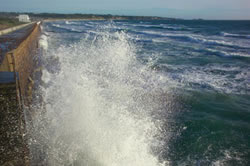
waves are caused by the wind as it blows across the sea. Waves
are a powerful source of energy.
The problem is that it's not easy to harness this energy and convert it into electricity in large amounts. Thus, wave power stations are rare.
|
| There are several methods of getting energy from waves. One of them works like a swimming pool wave machine in reverse. At a swimming pool, air is blown in and out of a chamber beside the pool, which makes the water outside bob up and down, causing waves.
|
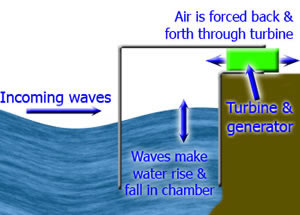 |
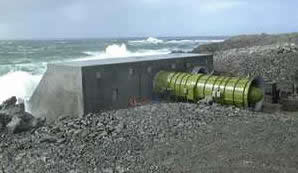
At a wave power station, the waves arriving cause the water in the chamber to rise and fall, which means that air is forced in and out of the hole in the top of the chamber. We place a turbine in this hole, which is turned by the air rushing in and out. The turbine turns a generator. A problem with this design is that the rushing air can be very noisy, unless a silencer is fitted to the turbine. The noise is not a huge problem anyway, as the waves
make quite a bit of noise themselves. |
|
| |
|
 |
| Example:
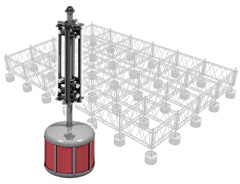
A company called SINN Power based in Germany uses a simpler, modular approach - which means that the system is easier to make and is made of units, and you can install as many units as you need.
|
Video
Clip: Wave Energy Converter Arrays |
| Example: Another
company is called Renewable Energy Holdings. Their idea for
generating wave power (called "CETO") uses underwater
equipment on the sea bed near the coast. Waves passing across the
top of the unit make a piston move, which pumps seawater to drive
generators on land.
|
Video
Clip: CETO |
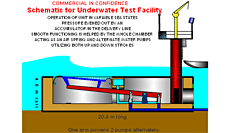
| Example: The Oyster wave energy device 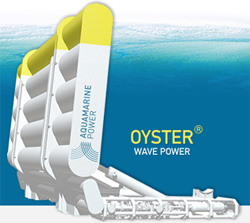
The action of the waves moves the device, pumping hydraulic fluid to a shore station to drive a generator. |
More ideas about how to extract energy from waves are being proposed all the time. This page only shows a few examples.
Once you've built a wave power station, the energy is free, needs no fuel and produces no waste or pollution.
One big problem is that of building and anchoring something that can withstand the roughest conditions at sea, yet can generate a reasonable amount of power from small waves. It's not much use if it only works during storms!
 Advantages
|
Is it renewable? Wave power is renewable.
 |
 |
Home Fossil Fuels Nuclear Power Solar Power Wind Power Tidal Power Hydroelectric Power Pumped Storage Wave Power Geothermal Power
Biomass Biogas Other Biofuels See also "Stuff to do" on the home page.
This site uses images from www.freefoto.com and www.sxc.hu I am not responsible for the content of external sites linked from this page.