Can't see the menu?
Try the text links at the bottom.
Energy Resources:
Solar power
Solar Power: Energy from the sun 
Custom Search
|
See a French translation of this page
See a Japanese translation of this page
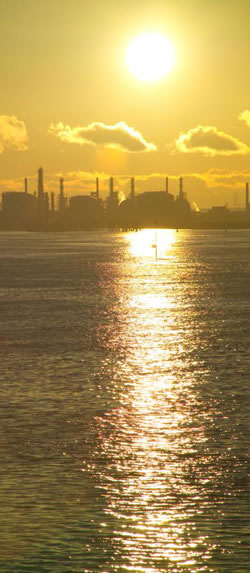
We've used the Sun for drying clothes and food for thousands of years, but only recently have we been able to use it for generating power. The Sun is 150 million kilometres away, and amazingly powerful. Just the tiny fraction of the Sun's energy that hits the Earth (around a hundredth of a millionth of a percent) is enough to meet all our power needs many times over. In fact, every minute, enough energy arrives at the Earth to meet our demands for a whole year - if only we could harness it properly. Currently in the UK there are grants available to help you install solar power in your home. Visit www.solarpanels.co.uk to see examples of solar products. |
 |
 How it works:
 There are three main ways that we use the Sun's energy:-
| 1 Solar
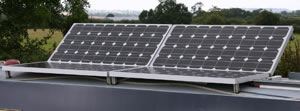
Cells There's an infographic here to explain how they work |
 |
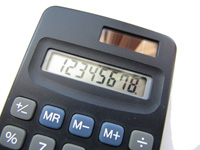 |
In a sunny climate, you can get enough power to run a 100W light bulb from just one square metre of solar panel. This was originally developed in order to provide electricity for satellites, but these days many of us own calculators powered by solar cells. |
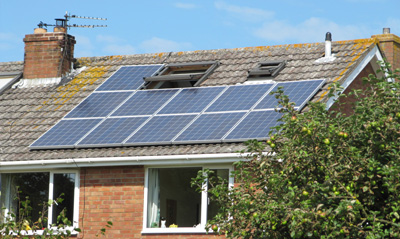
People are increasingly installing PV panels on their roofs. This costs thousands of pounds, but if you have a south-facing roof it can help with your electricity bills quite a bit, and the government pays you for any extra energy you produce and feed back into the National Grid (called the "feed-in tariff").
|
|
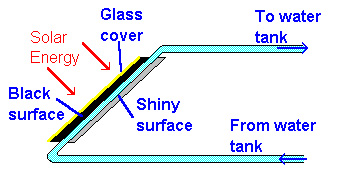
| 2 Solar water heating, where heat from the Sun is used to heat water in glass panels on your roof. This means you don't need to use so much gas or electricity to heat your water at home. Water is pumped through pipes in the panel. The pipes are painted black, so they get hotter when the Sun shines on them. The water is pumped in at the bottom so that convection helps the flow of hot water out of the top. |
 |
Solar water heating is easily worthwhile in places
like California and Australia, where you get lots of sunshine.
Mind you, as technology improves it's becoming worthwhile in the
UK. |
| Here's a more
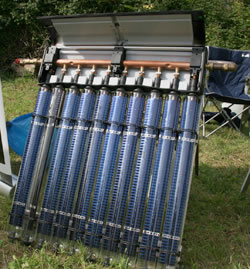
advanced type of solar water heating panel. This "Thermomax" panel is made of a set of glass tubes. Each contains a metal plate with a blue-ish coating to help it absorb solar energy from IR to UV, so that even in diffuse sunlight you get a decent output. The air has been removed from the glass tubes to reduce heat loss, rather like a thermos flask. Up the back of the metal plate is a "heat pipe", which looks like a copper rod but contains a liquid that transfers heat very quickly to the top of the glass tube. A water pipe runs across the top of the whole thing and picks up the heat from the tubes.
|
 |

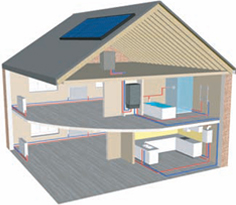
The main way that a conventional gas "combination boiler" continually wastes energy is by replenishing stored water as soon as the volume or temperature decreases. With solar powered boilers, this is instead fuelled by the solar power collected through panels on the roof of your home. The power collected through the solar tiles is used to fuel and therefore heat a separate water cylinder, thus saving energy throughout the course of every day. Another smaller tank, still powered by gas, is provided with most solar boiler installations as a backup. |
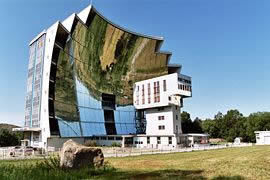
| 3 Solar Furnaces use a huge array of mirrors to concentrate the Sun's energy into a small space and produce very high temperatures. There's one at Odeillo, in France, used for scientific
experiments. |
 |
|
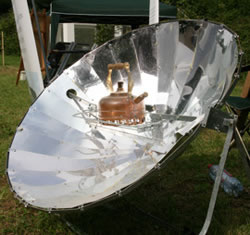
Solar furnaces are basically huge "solar cookers". A solar cooker can be used in hot countries to cook food. This one is in the UK, making tea and coffee, although it does take a long time! |
 More:
More: 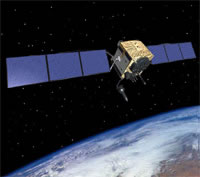 |
Solar cells provide the energy to run satellites that orbit the Earth. These give us satellite TV, telephones, navigation, weather forecasting, the internet and all manner of other facilities. The graphic shows a GPS satellite. A satellite navigation receiver
in a car gets signals from a whole host of these and works out it's
own position. |
In California, the Solar One power station uses the Sun's heat to make steam, and drive a generator to make electricity. The station looks a little like the Odeillo solar furnace , except that the mirrors are arranged in -circles around the "power tower". |
 |
As the Sun moves across the sky, the mirrors turn to keep the rays focussed on the tower, where oil is heated to 3,000 degress Celsius, The heat from the oil is used to generate steam, which then drives a turbine, which in turn drives a generator capable of providing 10kW of electrical power.
Solar One was very expensive to build, but as fossil fuels run out and become more expensive, solar power stations may become a better option.
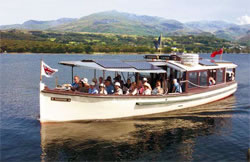
There are solar powered electric boats on Coniston Water in the Lake District, England.
|
Video clip: How PV solar
panels are made |
| One idea that is being considered is to build
solar towers.
The idea is very simple - you build a big greenhouse, which is warmed by the Sun. In the middle of the greenhouse you put a very tall tower. The hot air from the greenhouse will rise up this tower, fast - and can drive turbines along the way. This could generate significant amounts of power, especially in countries where there is a lot of sunshine and a lot of room, such as Australia. |
Video clip:
solar tower |
- Solar energy is free - it needs no fuel and produces
no waste or pollution.
- In sunny countries, solar power can be used where
there is no easy way to get electricity to a remote place.
- Handy for low-power uses such as solar powered
garden lights and battery chargers, or for helping your home energy
bills.
Disadvantages - Doesn't work at night.
- Very expensive to build solar power stations, although
the cost is coming down as technology improves. In the meantime, solar
cells cost a great deal compared to the amount of electricity they'll
produce in their lifetime.
- Can be unreliable unless you're in a very sunny climate. In the United Kingdom, solar power isn't much use for high-power applications, as you need a large area of solar panels to get a decent amount of power. However, technology has now reached the point where it can make a big difference to your home fuel bills..
Is it renewable? Solar power is renewable. The Sun will keep on shining anyway, so it makes sense to use it.
 |
 |
Home Fossil Fuels Nuclear Power Solar Power Wind Power Tidal Power Hydroelectric Power Pumped Storage Wave Power Geothermal Power
Biomass Biogas Other Biofuels See also "Stuff to do" on the home page.
This site uses images from www.freefoto.com and www.sxc.hu I am not responsible for the content of external sites linked from this page.