Many people have contributed to today's understanding
of radioactivity.
This page is intended to tell you a little about some of the most
famous scientists in this field.
 Henri
Becquerel
Marie & Pierre Curie
Ernest Rutherford
Hans Geiger Henri
Becquerel
Marie & Pierre Curie
Ernest Rutherford
Hans Geiger
|
To put their work in context, it is worth summarising
how our present-day model of the atom came about:
- The concept of Atoms dates back to the ancient
Greeks. They thought that matter could be made up of tiny
building blocks. They imagined that everything was made
of combinations of four elements : earth,air, fire, and
water.
- Isaac Newton, in 1687, said
that the relationships we see between pressure, volume and
temperature in gases could be explained if we assume that
the gas is made of tiny particles.
|
|
- During the 19th Century, the modern idea
of elements grew.
In 1808, John Dalton suggested that each element was made
of identical atoms.
In 1811 Amedeo Avogadro proposed that these atoms could
stick together to form molecules.
By 1895 the sheer weight of evidence was that, although they were
too small to see, atoms and molecules were real.
- JJ Thomson proposed the "Plum-pudding" model
of the atom. (He also discovered the existence of electrons, in
1897). This model was an attempt to explain the discovery of both
positive and negative charges within the atom. He said that the
negative charges were scattered throughout a positively charged
atom, like currants in a bun.
- In 1911, Ernest Rutherford put forward
his model of the atom. This proposed that all the positive charges
were concentrated in a tiny nucleus, and the electrons orbited
around the outside of the atom.
- In 1932, James Chadwick discovered the neutron. The discovery
of this uncharged particle explained the large masses of the elements
compared to their number of charges.
- There was a problem with the Rutherford model, in that classical electromagnetic theory
said that the orbiting electrons ought to radiate energy, their
orbits should decay rapidly and they should fall in to the nucleus.
In 1913, Niels Bohr proposed an updated model, which included
some modern quantum theory. This allowed for electrons to move
in orbits, as in the Rutherford model.
Bohr's ideas included electrons only being allowed to follow
certain fixed orbits, leading to the concept of electron shells
that we use in chemistry.
Our modern understanding of the atom is based on these early models.
We now know that protons and neutrons are themselves made of smaller
particles called "quarks", and that at the subatomic level,
the laws of probability appear to govern the processes.
Henri
Becquerel (1852 - 1908) |
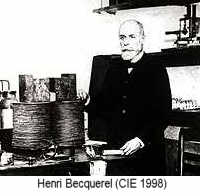 In 1896, the French scientist
Henri Becquerel discovered that crystals of a Uranium compound would
darken photographic plates (like our modern photographic film),
even through black paper that kept out all light. In 1896, the French scientist
Henri Becquerel discovered that crystals of a Uranium compound would
darken photographic plates (like our modern photographic film),
even through black paper that kept out all light.
He thought that the compound must have been giving off some other
form of radiation, which could pass through the paper. Marie
Curie later named this "radioactivity".
He shared the Nobel Prize for Physics with Marie
and her husband, Pierre, in 1903.
Becquerel was born in Paris, and studied at the Ecole Polytechnique.
In 1892, he became professor of physics at the Museum of Natural
History, and in 1895 also at the Ecole Polytechnique. He was elected
president of the French Academy of Sciences in 1908.
We now name a unit after him:
one Becquerel
(Bq) is one disintegration per second of a radioactive substance.
|
In 1898, following Becquerel's
discovery, the French physicists Marie
and Pierre Curie found other substances
that emitted radioactivity.
Their work focussed the attention of scientists
on this strange new phenomenon and led to a wide range of
experiments.
A unit of radioactivity is named after
Marie:
one Curie is the activity of a substance which undergoes 3.7
x 10^10 disintegrations per second.
The radioactive sources you'll see in schools probably have
activities around 5 micro-curies.
|
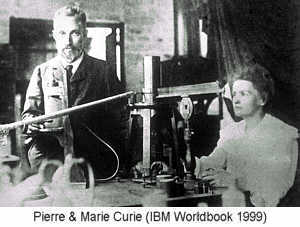 |
Marie Curie (1867- 1934)
Born in Poland as Marie Sklodowska in 1867,
from childhood Marie had a remarkable memory. At the age
of 16 she started work as a teacher, then as a governess,
using her earnings to pay for her sister Bronia's medical
studies.
In 1891 she went to Paris, where she studied
Physics. In the spring of 1894 she met her husband-to-be,
Pierre Curie. Marie began looking
for substances that emitted radioactivity. She studied a
substance called pitchblende extensively, an ore with a
surprisingly high activity.
Pierre joined her in
this work, and together they discovered two new radioactive
elements, naming them Polonium and Radium. Pierre studied
the radiations, whilst Marie worked to obtain a sample of
pure Radium. She received her doctorate of science in 1903,
and Becquerel & the Curies shared the Nobel Prize for
Physics that same year.
|
|
Marie had two daughters, Irène and Eve. She was appointed
lecturer in Physics at the École Normale Superieure in
Sèvres in 1900, and introduced teaching methods based on
experimental demonstrations. The sudden death of her husband in
a road accident in 1906 was a huge blow to Marie. From then on,
she devoted her energy to completing the scientific work they
had done together.
In 1911 she was awarded the Nobel Prize for chemistry, having
finally isolated pure Radium. Throughout the First World War,
Marie and her daughter, Irène, worked on X-radiography.
After the war she devoted her researches to discovering medical
uses for radioactivity.
In 1934, Marie died of leukaemia caused
by her extensive work with radiation. Her contribution to modern
Physics was immense. In 1995 her ashes were placed in the Panthéon
in Paris, the first woman to receive this honour for her own achievements.
Pierre Curie (1859 - 1906)
Pierre was educated by his father, who was a doctor. By the age
of 14, he had developed a passion for mathematics, and showed
a particular talent for spatial geometry, which was to be useful
in his later work on the structure of crystals.
In 1878 Pierre was taken on as a laboratory assistant at the
Sorbonne, where he carried out work on the wavelength of Infra-red
waves and studied the symmetries of crystals. With his brother,
Jacques, he discovered piezoelectricity, in which stresses on
a crystal can generate electricity. This is used in modern gas
lighters, and small speakers and microphones.
After being appointed as supervisor at the School of Physics
and Industrial Chemistry in Paris, he worked on magnetism, leading
to the formulation of Curie's Law, which relates a type of magnetic
attraction and temperature.
Pierre Curie married Marie Sklodowska in
1895, and they worked together on radioactivity (see above). Pierre
concentrated on the radiations themselves, and used magnetic effects
to prove that radioactive substances gave off positive, negative
and neutral rays. Ernest Rutherford
was later to name these alpha particles, beta particles, and gamma
rays.
Pierre also observed the effects of radiation on the body, laying
the foundations for radiotherapy, used in modern cancer treatments.
He refused a post at the University of Geneva in order to continue
his work with Marie. In 1904 he was appointed professor at the
Sorbonne, and was elected to the Academy of Sciences in 1905,
having jointly received the Nobel Prize for Physics with Marie
Curie and Henri Becquerel in 1903.
He was killed instantly when he was run over by a cart in the
Rue Dauphine in Paris in 1906. Pierre Curie was one of the founders
of modern Physics.
Lord
Ernest Rutherford (1871 - 1937) |
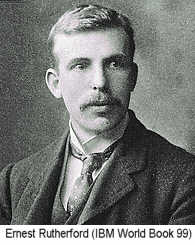 Born
in Spring Grove, New Zealand, Ernest was the fourth of twelve children.
His parents, who had emigrated from Britain, lived simply in order
to be able to afford to educate their children. Born
in Spring Grove, New Zealand, Ernest was the fourth of twelve children.
His parents, who had emigrated from Britain, lived simply in order
to be able to afford to educate their children.
In 1887 Ernest won a scholarship to Nelson College, where he went
on to win prizes in history, languages, and mathematics. With the
aid of another scholarship he gained a place at Canterbury College,
Christchurch, and graduated in 1892 with first-class honours in
mathematics and physics. Staying on, he taught part-time to fund
his research into magnetic fields. He discovered that he could detect
the then newly-discovered radio waves even after they had passed
through brick walls.
Before leaving New Zealand for England, he became unofficially
engaged to Mary Newton, a daughter of his landlady in Christchurch.
He wrote her many letters from England, which have been preserved
and today tell us much about this fascinating personality.
Arriving in Cambridge in 1895, Rutherford began work under JJ
Thomson at the Cavendish Laboratory, where he made a great impression
on colleagues. The story goes that he had such a loud voice that
he disturbed experiments in the Cavendish and they had to hang up
"Quiet Please" signs.
Following work on X-rays, Rutherford
studied the rays emitted from Uranium compounds discovered
by Henri Becquerel. He showed that
they were different to X-rays, that they
ionised air and were made of charged particles. We now
know them as alpha and beta particles.
In 1898 Rutherford was appointed to the chair of physics
at McGill University in Montreal, and in the summer of 1900
he travelled to New Zealand to marry Mary Newton.
When their first daughter was born, he wrote to his mother
that" ... it is suggested that I call her ' Ione' , after
my respect for ions in gases".
|
|
"Rutherford's Experiment" provided the
most important evidence for the internal structure of the atom:
Geiger and Marsden,
working for Rutherford, performed an experiment in which alpha
particles were fired at a very thin gold foil. They found that
the vast majority of the particles passed straight through, and
that only a few were deflected off-course. Even fewer were deflected
back the way that they came.
This led him to the conclusion that the atom had a tiny, dense,
positively-charged nucleus. Anything lighter would not be able to
repel heavy alpha particles back the way they came. Thus the negatively-charged
electrons must be somewhere around the outside of the atom.
He also discovered that radioactive decay is not affected by external
conditions.
Rutherford was elected president of the Royal Society in 1925,
and made many other significant contributions in the field of physics.
In 1931 he was made a peer. He died in Cambridge in 1937, following
a short illness, and was buried in Westminster Abbey.
Hans
Geiger (1882 - 1945) |
Johannes Wilhelm Geiger
was a German physicist who introduced the first reliable detector
for alpha particles and other ionising
radiation.
We still use his basic design today, although more advanced detectors
are also in use.
Geiger gained his PhD at the University of Erlangen in 1906, then
joined the University of Manchester, becoming one of Ernest Rutherford's
most valued colleagues. Here he built his first particle counter
and used it in experiments that identified alpha particles as being
the same as the nucleus of a Helium atom.
In 1912 he moved to the German National Institute for Science and
Technology, where he continued to study atomic structure. Geiger
served as an artillery officer during the First World War.
He accepted his first teaching position in 1925 at the University
of Kiel, where he worked with Walther Müller to improve the
sensitivity and performance of his particle counter. The modern
Geiger-Müller tube detects both alpha and beta radiation, along
with other photons.
In 1929 Geiger moved to the University of Tübingen, where
he investigated cosmic rays, moving on to the Technische Hochschule
in Berlin in 1936 to work with nuclear fission and artificial radioactivity,
until his death in 1945.
|
