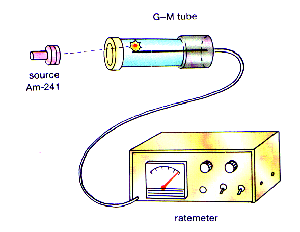
Most people have heard of a "Geiger Counter"
for measuring radioactivity. This is actually a Geiger-Müller tube with some form of counter
attached, which usually tells us the number of particles detected
per minute ("counts per minute").
GM tubes work using the ionising
effect of radioactivity. This means that they are best at
detecting alpha particles, because -particles
ionise strongly.
Different models of GM tubes are available for
detecting ,
and
radiation.
How it Works
You
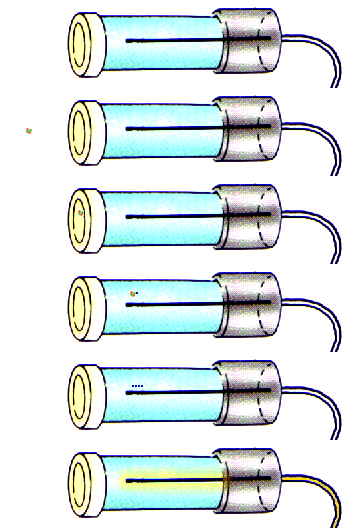
can see how the tube works in the animation.
The tube is filled with Argon gas, and around +400 Volts is
applied to the thin wire in the middle. When a particle enters
the tube, it pulls an electron from an Argon atom. The electron
is attracted to the central wire, and as it rushes towards
the wire, the electron will knock other electrons from Argon
atoms, causing an "avalanche". Thus one single incoming
particle will cause many electrons to arrive at the wire,
creating a pulse which can be amplified and counted. This
gives us a very sensitive detector.
Photographic
Film
In 1896, Henri Becquerel, working
in Paris, discovered that Uranium compounds would darken a photographic
plate, even if the plate were wrapped up so that no light could
get in.
Radioactivity will darken
("fog") photographic film, and we can use
this effect to measure how much radiation has struck the film.
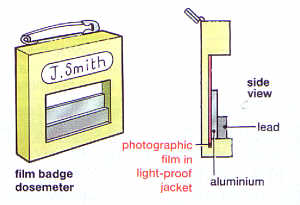
Workers in the nuclear industry wear "film
badges" which are sent to a laboratory to be developed,
just like your photographs. This allows us to measure the
dose that each worker has received (usually each month).
The badges have "windows" made of different materials,
so that we can see how much of the radiation was alpha particles,
or beta particles, or gamma rays.
The
Gold Leaf Electroscope
Dry air is normally a good insulator, so
a charged electroscope will stay that way, as the charge cannot
escape.
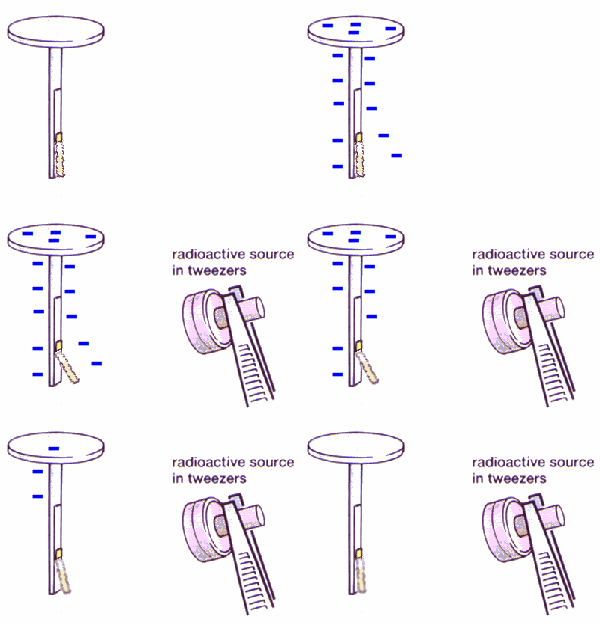
When an electroscope is charged, the gold leaf
sticks out, because the charges on the gold repel the charges
on the metal stalk.
When a radioactive source comes near,
the air is ionised, and starts to conduct electricity. This
means that the charge can "leak" away, the electroscope
discharges and the gold leaf falls.
The
Spark Counter
An early form of detector, the Spark Counter
is another instrument that uses the ionising effect of radioactivity,
and for this reason it works best with particles.
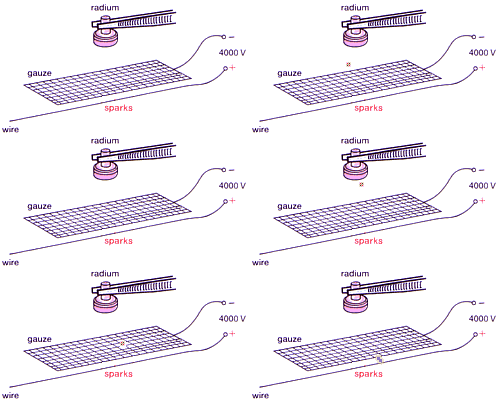
A high voltage is applied between the gauze
and the wire, and adjusted until it is just below the voltage
required to produce sparks.
When a radioactive source is brought
near, the air between the gauze
and the wire is ionised, and sparks
jump where particles pass.
The
Cloud Chamber
There are two types of cloud chamber: the "expansion"
type and the "diffusion" type.
In both types, alpha or beta particles leave
trails in the vapour in the chamber, rather like high-altitude
aircraft leave trails in the sky.
The chamber contains a supersaturated vapour
(e.g. methylated spirits), which condenses into droplets when
disturbed and ionised by the passage of a particle (alpha
particles are best for this).
You can clearly see the direction and energy of the particles
(low energy particles only leave short trails).
Occasionally, a particle collides with an air molecule and
changes direction.
A cloud chamber shows the randomness of radioactive emissions
clearly.
Expansion cloud chambers use a vacuum pump
to briefly produce the right conditions for trails
to form, whilst the Diffusion type shown in the video uses
solid Carbon Dioxide to cool the bottom of the chamber and
produce a temperature gradient in which trails can be seen
continuously.
Video
Clip: Diffusion Cloud Chamber
The
Bubble Chamber
A similar idea to an expansion cloud chamber, particles leave trails
of tiny bubbles in a liquid. This used to be the main instrument for
tracking the results of collisions in particle accelerators.
The chamber would be surrounded by powerful magnets, so any
charged particles passing though the chamber would move in
curved paths. The shapes of the curves tell us about the charge,
mass and speed of each particle, so we can work out what they
are - otherwise one line of bubbles looks pretty much like
another.
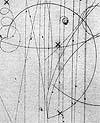
Particle tracks in a bubble chamber
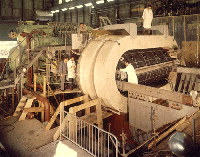
Technicians at CERN working on a bubble
chamber in 1970
Modern
Detectors
Modern instruments are much more sensitive than the others listed
on this page.
"Scintillation Detectors" work by the radiation
striking a suitable material (such as Sodium Iodide), and producing
a tiny flash of light. This is amplified by a "photomultiplier
tube" which results in a burst of electrons large enough to
be detected. Scintillation detectors form the basis of the hand-held
instruments used to monitor contamination in nuclear power stations.
They can recognise the difference between a, b and g radiation,
and make different noises (such as bleeps or clicks) accordingly.
"Solid-State Detectors" are the most up-to-date
instruments. They are used in particle-accelerator laboratories
to show the results of high-energy collisions, with banks of them
clustered around the collision site, feeding data into huge computers.
The way they work is way beyond what we need for GCSEs, but
basically they are similar to the CCD Silicon chips used in video
cameras.
Find
out about the units we use to measure radioactivity:


 -particles
ionise strongly.
-particles
ionise strongly. and
and
 radiation.